Why MQLs Are Dead. And What Replaces Them.
The metric that ran B2B marketing for fifteen years is now actively misleading the AI tools you bought to fix it. Here is what replaced it.
By Lara Shackelford, CEO, Hawksmoor.ai · April 27, 2026
The Day We Killed the MQL
Before Hawksmoor, I ran demand for a Fortune 50 commercial cloud business. The team took it from $23B to $51B in revenue. The product was great. The engine underneath ran on Signal Integrity. Eighty signals per account, pulled daily, before AI was even a category.
And it still was not enough. One region started missing its number. Lead conversion was dropping and we caught it every time, but always weeks or months too late. The MQL was the wrong metric. It counted activity instead of intent. Every team defined it differently.
So we killed it. The next morning, nobody across the Americas could see an MQL report anywhere. Marketing could not see the count. Sales could not pull from it.
“One day, we killed the MQL. There was silence in the hallways for a week.”
Global Demand Center lead, Fortune 50 commercial cloud business.
We replaced it with the Marketing Engagement Index. Account behavior, market timing, and what each account was most likely to buy next, all scored by AI with humans owning the definitions underneath.
The Three Failures That Killed It
The MQL did not just decline. It failed in three specific ways. The same three failures still produce broken pipelines today, only with a thousand times the blast radius.
Semantic failure. Four teams. Four definitions of qualified. Back in 2018 a misaligned definition produced wrong emails. In 2026, one bad definition fires ten thousand wrong emails before anyone wakes up.
Temporal failure. A regional problem used to surface in the quarterly review. Today stale scores route renewals to the wrong rep instantly, and the agent never asks if the scoring logic is still current.
Lineage failure. Three systems used to give three different answers when the CFO asked why. Now agents fire autonomously and nobody can explain why after the fact. AI does not fail because the models are weak. It fails because the signals underneath are broken.
What Replaces It: The Marketing Engagement Index
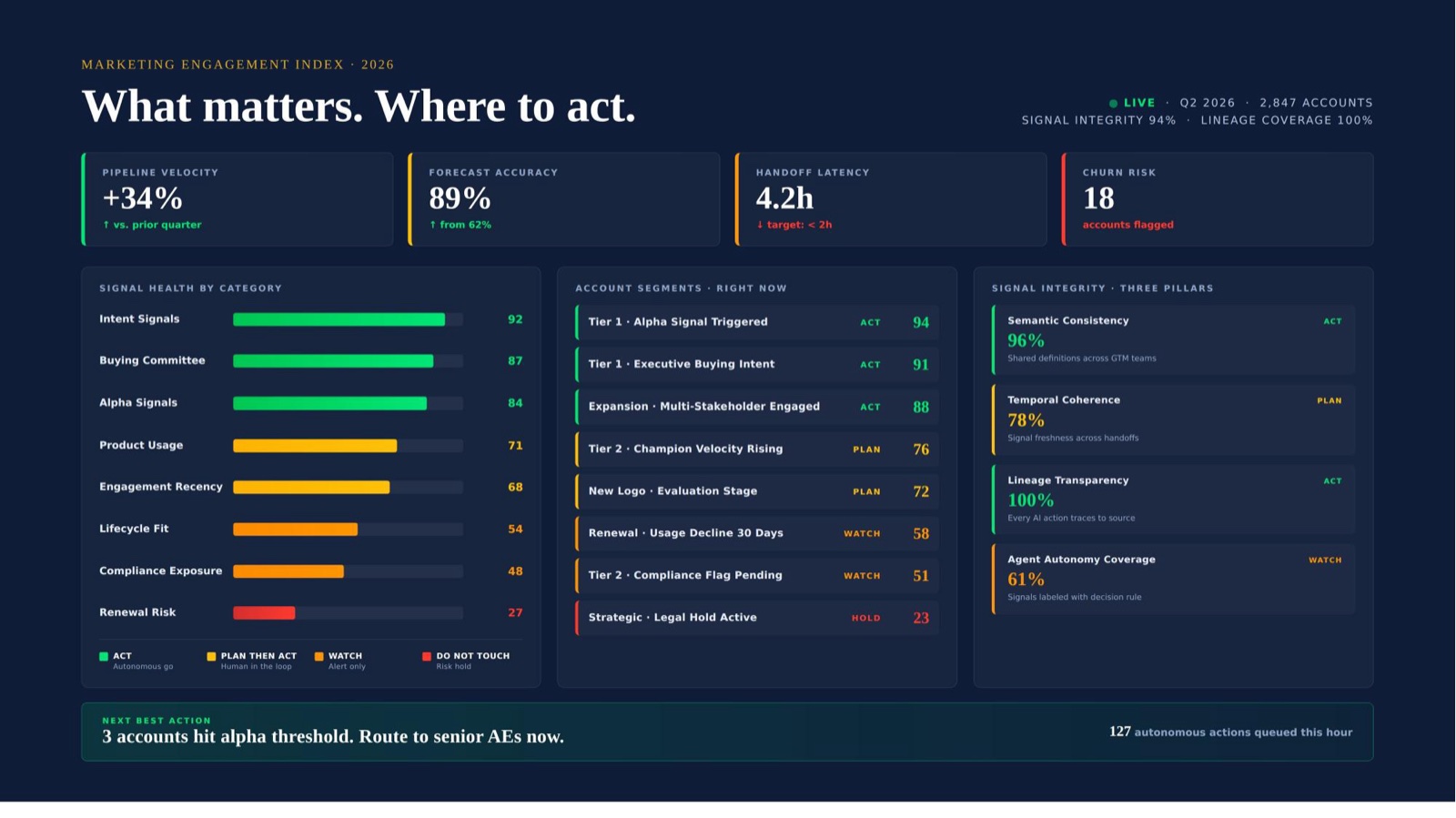
MEI scores buying-committee behavior across eight signal categories: Intent Signals, Buying Committee, Alpha Signals, Product Usage, Engagement Recency, Lifecycle Fit, Compliance Exposure, and Renewal Risk.
Each score carries an action level. ACT when the signal is clean and the agent goes autonomously. PLAN THEN ACT when judgment is required and a human is in the loop. WATCH when caution demands an alert without action. DO NOT TOUCH when risk holds the signal entirely. AI orchestration knows not just what a signal scores, but who acts on it and how.
Alpha Signals: The Differentiator
Eighty signals became eighty-three. The shift was not the number. It was the ones we added.
Alpha signals are the ones competitors cannot see. Board filing language shifts. Executive LinkedIn velocity. Champion velocity inside an account. Pending compliance exposure. Peer settlement precedent.
These do not come from your marketing automation. They come from signal architecture. They are the ones that move markets, not dashboards.
Your Monday Morning Move
You do not need budget. You need two hours and the right people in a room.
- Assess. Get marketing, sales, and RevOps in one room with a whiteboard. Write down what qualified, engaged, and at-risk mean. Nobody leaves until those words mean the same thing to everyone.
- Prioritize. Pick two or three quick wins this quarter. Not a massive program. A handful of fixes that prove the architecture can move.
- Inventory. Label every signal in the stack as autonomous, human-in-the-loop, or alert-only. If the team cannot answer in sixty seconds, the orchestration layer does not exist yet.
- Build. Automate with lineage from day one. Every AI action has to trace back to the signal that triggered it.
AI did not break your go-to-market. It revealed what was already broken. Read the full MEI definition in the GTM Glossary →
Start with clarity. Take the GTM Assessment.
5-minute diagnostic. Instant insights.